
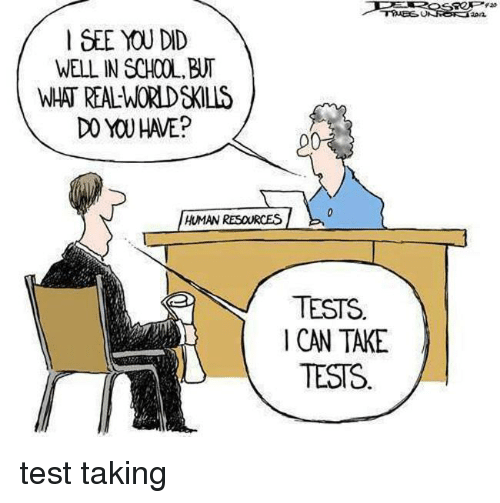
I’m going to be honest, I don’t remember a whole lot from middle school assessments so this may be me recalling a shaky memory. From what I remember from middle school, tests and quizzes were the most common form of assessments given by my teachers in middle school. The only other real assessment that I can recall other than those are the homework grades that were practically a review of the material that we learned in class that day. I feel that middle school assessments today have come a long way from what they were when I was in middle school. I can’t even think of any other way that I was assessed besides projects, tests, quizzes, and homework. Projects, of course, being my favorite type of assessment because it allowed for us to show off our creativity and knowledge. Tests, quizzes, and homework were always boring and felt overwhelming. I do, however, remember the county test referred to as the dreaded CRCT. I say dreaded because teachers make you feel like your life depend on whether or not you pass this test. That may be true, but can you guys not stress me out that much. If I recall, the CRCT wasn’t even really that hard of a test. I don’t think I studied for any of them throughout middle school. To build on that, how does one test decide whether you move on to the next grade? What if I had straight A’s and just wasn’t feeling it the day of the CRCT? Seems weird, but I guess the county knows what’s best for the students.
In my recent field experience I have noticed vast changes in the way that teachers assess students. Although tests, quizzes, homework, and projects are still a large part of the assessment process, there are also several new ways in which I’ve seen students assessed in the classroom. Don’t get me wrong, I do believe that these archaic assessment strategies are relevant and efficient ways to assess students, but I like to have a change up everyone once in a while. The teacher that I have observed in my field experience have assessed students by using group projects (videos, posters, songs, PPTs (aka differentiation)), plays, discussions, and hands on labs. My favorite assessment of those is the differentiated projects. The students got really creative and actually enjoyed creating things that were relevant to the content material. I may have to use this one in my future practice because the students were very engaged. Discussions are probably one of the newest ways to assess in which I’ve seen recent teachers implement into their classroom. Although these discussions are not for a grade, the students are still being assessed on their knowledge of the content. I feel that teachers are starting to implement discussion based classrooms a little more than they used to when I was in school. I remember most of my social studies teachers just did notes all day with VERY FEW other activities. The classic GCPS standardized tests, such as performance exams, Midterms, and EOCTs are still prevalent in the Gwinnett school systems. Teachers that I observed spent a lot of time preparing students for these exams, especially for the performance exam. The performance exam is a little bit different than your average standardized tests from GCPS. This test required students to create an essay relevant to the content. I think these tests weren’t too overbearing. I can see why teachers would implement a lot of tests, quizzes, and essays in order to prepare students for the real deal when the county tests come around. I think that the most effective form of testing is probably the discussion based assessment. Students are forced to be engage and give their opinion, especially in a student based discussion. This form of assessment strategy allows for students to think on a deeper level than finding out if a question is A, B, C, or D on a standardized test.
I think that literacy is an important part of education for students. That is why I think literacy based assessments should be implemented frequently by teachers. Specifically for history, I think teachers can use presentations, video reenactments, or even songs based on a particular event. There are many ways in which teachers can create fun and engaging activities that assess a students literacy in a historical setting. Presentations are always a good way to get students out of their comfort zone and allow them to practice their speaking skills. Video reenactments, in my opinion, are always exciting and students can really get in to that kind of stuff. The same goes for creating a song. Students like to have the opportunity to be creative and bring their own ideas into the classroom. Another form of literacy assessment could be as simple as writing a short summary about something that they just read or that was just taught to them. Teachers can tell students to give their own opinions and allow them to express their thoughts on a particular event in history, rather than summarizing a text. I do, however, feel that students need to be able to comprehend a text and be able to summarize it in their own words. This is a crucial part of education especially considering they will see this form of assessment type for THE REST OF THEIR LIVES.
So, in conclusion, I think we’ve come a long way from when I used to be in middle school and high school. I think that teachers are looking for more ways to involve students create a more students centered classroom. I believe that tests, quizzes, and essays will always be around. I think these forms of assessments are crucial to a students education, but teachers are now finding new ways to be able to assess their students. Literacy is one of the most vital forms of education for students, and I think there is a way to implement it in all content areas. Teachers can get creative and find engaging ways to assess students on a literacy basis. I truly don’t know what the best way to assess a student is, but I think it can be effective to allow students to bring their own creativity into the classroom that is relevant to the content material.
 Ace Baloosh