
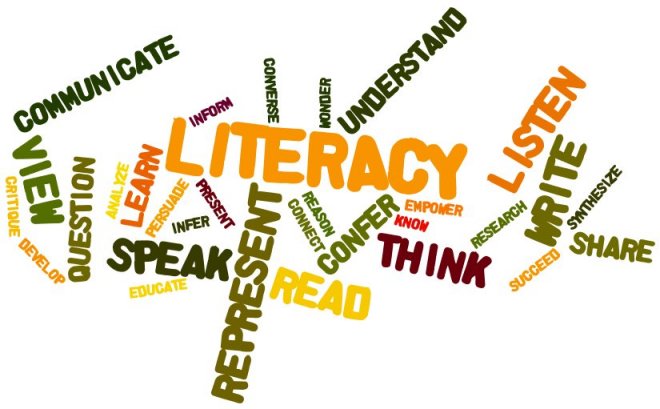
I think that my knowledge of literacy in and outside of the classroom have expanded exponentially. Literacy is a part of our daily lives and impacts us almost everyday. What I have learned about the importance of literacy has made me want to pick up a book again. And guess what? It’s not a book that I was forced to read. Im actually reading on my own time and learning how to comprehend like a movie. This is all due to the strategies that I have been introduced to throughout my semester in READ3400. Here’s the thing though, literacy is not just about reading books. Literacy can take on many forms, such as videos, audio, and even just speaking. You can see why literacy is such an important part of our daily lives. We do at least one of these activities on a daily basis. Whether you are texting and friend, using social media, or watching Avengers: Endgame, you are using your literacy abilities.
During my semester of student teaching in my Mrs. Bradford’s 7th grade class has showed me a lot about the level that students at this age are on. One thing that surprised me the most was the fact that a lot of these students are reading book that are almost on a level that I am at (which is scary). I was blessed to work with some wonderful gifted students at Berkmar Middle School that have opened my eyes to the literacy world of the future. Let’s start with books. For the most part, students at Berkmar love their horror stories. Over 50 percent of the students would prefer a scary book over any other genre. That’s the same for me too. There’s something about the suspense of a horror story that keeps you on the edge of your seat. If i could somehow relate a scary story to whatever subject I am teaching in history, I know those kids would be engaged. Alright, now let’s talk about writing. Most of the students that I asked were not big fans of writing. This isn’t a surprise to me. Most students have been forced to write about something that they do not have interest in. Let these kids write about something that interests them. Maybe when I have my own classroom, every Monday, I’ll allow students to just write me a quick 5 minute “How was your weekend” paragraph just to get those brain cells pumping after a long weekend. Give them something they want to write about and I’m sure you’ll see more engaged writings. Alright, now videos. Not a shocker that most of the students also preferred horror movies, but a good comedy movie can always keep kids engaged. I already try to implement comical videos into my lessons, and I’m sure that I will continue to do so when it comes to teaching my own classroom. I’m definitely sure I can find some horrific historical events that will “wow” students as well. What do they listen to? Music. These kids love their music. So do I. I got all kinds of different genres that kids listen to. The predominant genre that appeared was Hip Hop. Hip Hop is sweeping the younger generations. I just made the cut because it swept me too. I love how I could relate to my students talking about Hip Hop music. I even played a Gandhi rap video in one of my lessons and the kids absolutely loved it. I will definitely be bringing music into my classroom. I want kids to see the fun side of learning. I know where to find those goofy rap videos that still provide the basic knowledge that students need to know. What do these students like to create? Although I don’t believe I touched on this subject with my adolescent literacy project, I did get to see the drawing that kids love to put on their assignments. I can tell that a lot of students like to doodle and draw pictures of popular television characters. I like to acknowledge the drawings on the students’ work that they turn in just to give them a little thumbs up to keep up that literacy! I almost forgot about social media. Now here’s a big daily literacy practice. Students love their social media. Whether they are reading posts or writing posts, it’s literacy! Snapchat and Instagram seem to be the big ones these days. Goodbye to Facebook I guess. So there you have it. A whole lot of literacy happening in this younger generation that I bet you didn’t even know existed. For all of you younglings that may see this one day, keep doing what you’re doing. Dont stop the literacy. Just don’t forget the to, too, twos and their, there, they’res.
I think that there are a lot of way to implement these practices into the classroom. As you can see in the above paragraph, I listed quite a few. For history, there are numerous videos and audios that you can use to help teach kids what they need to know. It doesn’t always have to be a document or text that students need to read. Spread the literacy love. When it comes to reading and writing in the classroom, it is imperative that teachers provide the resources and support that students need. In the “Subjects Matter” book, Daniels and Zemelman discuss multiple strategies, such as annotating and turn and talks, that can help students get the support that they need while reading difficult texts. These strategies can help students stop and think about what they are reading in order to comprehend the text better. I have always been a fan of reading aloud to the students and letting the students read aloud to the classroom as well. After a certain amount of paragraphs we regroup and talk about what we read. I feel like this forces engagement and allows students to practice talking in front of people.
I think that there are a lot of ways in which history teachers can implement literacy into their content area. There is so much information that is provided on so many platforms. When it comes to reading, students have to know how to decipher primary and secondary sources. If the teacher provides the right supports, this can be an easier task than it sounds. Primary documents are essential in deciphering first hand history from the point of view from people during the time in which a history event occurred. This can provide information that can give students a historical perspective. Secondary sources can also be interesting if the right sources are found. It is important that we provide students with the basic information, but try to include some interesting material that can get the attention of the students and create more engagement with the text. When it comes to writing, students can write all sorts of material related to history. One of my personal favorite things to have students write about is their opinion on a historical event. This gives students a little leeway to write what they want to write rather than being forced to write something that they could probably care less about. However, it is important for students to be able to write about specific historical events without an opinion. It is important to vary the writing assignments in class so that students are not overwhelmed with only factual summaries about historical events. When it comes to speaking, students can do presentations, eulogies of historical figures, and so on. There are many verbal literacies that can implemented into the classroom. One of my favorites that I would like to try in class is a speed dating activity where students are a historical figure and have to tell their “date” about themselves. I think that this would be a fun, engaging, and comical way to help students speak about history. When it comes to creating things, students can create memorials for historical figures, pictures of historical events, and so on. One thing that my MT liked to do was to have kids create a historical figure from construction paper and write down quotes or phrases that help describe the historical figure on the body. This was a fun and creative way for the students to work together and apply what they have learned from the content being discussed. I think that this course has really helped me open up to the world of literacy that many people do not fully understand yet. I now have a better grasp of the different ways to implement history into my content area. I also now have a better understanding of how to support those struggling readers and writers. I definitely feel like this course has helped me see the many ways in which I can use literacy in my content area.
Big shoutout to Dr. Amatucci for making me more aware of the literacy the surrounds us. I’m sorry that I called you Mrs. Amatucci for so long. You deserve the Dr. in front of name. That’s my bad. Keep doing what you’re doing, you’re good at it. This is Mr. Harrington (Ace Baloosh) signing off.




 Ace Baloosh